Mapping the New Commerce Corridors: A Strategic Case for Interstate Expansion in 2025
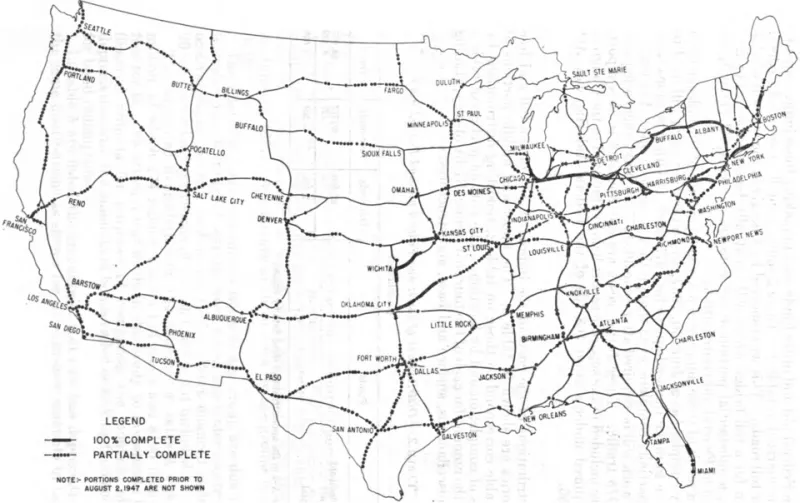
Photo: Bureau of Public Roads, Public domain, via Wikimedia Commons
For much of the past decade, the dominant conversation in US business strategy has centered on vertical integration and digital scale. Build deeper within your existing market, the conventional wisdom suggested, before attempting to expand horizontally. That counsel made sense in a period defined by digital platform growth and relatively stable domestic trade conditions. In 2025, however, the strategic calculus has shifted—and the businesses best positioned to capitalize on that shift are those actively mapping regional commerce corridors and engaging chamber advocacy to influence the policy environment shaping them.
This is not an argument for reckless expansion. It is an argument for deliberate, intelligence-driven regional growth that treats interstate commerce not as a distant aspiration but as a near-term competitive lever.
Why 2025 Represents a Structural Inflection Point
Several converging forces have made interstate commerce expansion more accessible and more strategically urgent than at any prior point in recent history. Supply chain restructuring following the disruptions of the early 2020s has prompted businesses across sectors to diversify sourcing and distribution geographically. The continued maturation of regional logistics infrastructure—particularly in the Southeast, Mountain West, and Upper Midwest—has reduced the friction costs historically associated with multi-state operations. And the ongoing evolution of state-level economic development incentive programs has created a genuinely competitive landscape in which businesses willing to establish cross-state presence can access meaningful financial advantages.
Simultaneously, the federal policy environment remains in active flux. Ongoing debates around interstate tax harmonization, cross-border professional licensing reciprocity, and regional infrastructure investment create both uncertainty and opportunity. Businesses that engage proactively with this environment—through chamber advocacy and direct policy participation—are better positioned to shape outcomes favorable to their operational interests.
Understanding the Regional Corridor Landscape
Not all interstate expansion opportunities are equivalent. The most strategically valuable approach is to identify and map specific regional trade corridors where complementary economic activity, infrastructure alignment, and policy environment create natural conditions for cross-state partnership.
Several corridors merit particular attention in the current environment:
The I-95 Northeast Corridor remains one of the densest commercial arteries in the country, but it is increasingly characterized by congestion costs and elevated operational overhead. Businesses anchored in this corridor are finding meaningful advantage in establishing secondary operations or supplier relationships in adjacent Mid-Atlantic and Southeast markets, where lower real estate costs and competitive labor markets improve overall unit economics.
The Gulf Coast Trade Zone, encompassing Texas, Louisiana, Mississippi, and Alabama, is experiencing substantial investment in port infrastructure and manufacturing capacity. For businesses in logistics, energy services, and industrial supply, this corridor offers both sourcing advantages and access to export infrastructure that is difficult to replicate elsewhere.
The Great Lakes Manufacturing Belt, spanning Michigan, Ohio, Indiana, and Wisconsin, is undergoing a significant reshoring-driven resurgence. Businesses in advanced manufacturing, automotive supply chain, and industrial technology should be actively evaluating partnership and distribution opportunities within this corridor, particularly given the concentration of state-level incentive programs targeting exactly these sectors.
The Mountain West Growth Corridor, stretching from Colorado through Utah, Nevada, and Arizona, continues to attract business migration from higher-cost coastal markets. The resulting concentration of growth-stage businesses creates genuine partnership and distribution opportunities for firms willing to establish relationships early in the corridor's development cycle.
Cross-State Tax Incentives: What Businesses Should Be Evaluating
State economic development agencies have become increasingly sophisticated in their use of tax incentives to attract multi-state business activity. For businesses considering interstate expansion, a structured evaluation of available incentives should precede any operational commitment.
Key categories of incentive worth examining include: qualified opportunity zone investments in economically distressed cross-state regions, job creation tax credits available in states actively competing for business relocation or expansion, research and development credits that vary substantially in generosity across state lines, and enterprise zone designations that can meaningfully reduce property and equipment costs for businesses establishing physical presence in targeted areas.
The complexity of navigating these programs across multiple state jurisdictions is non-trivial. This is precisely where chamber membership and advocacy infrastructure provide disproportionate value. GCCI USA maintains relationships with economic development officials and policy experts across regions, enabling members to access current, actionable intelligence on incentive availability without the overhead of maintaining those relationships independently.
Chamber Advocacy as a Policy Lever
Beyond facilitating individual business decisions, chamber organizations play a structural role in shaping the interstate commerce policy environment. This advocacy function is frequently underutilized by members who view their chamber primarily as a networking resource rather than as a mechanism for influencing the conditions in which their business operates.
In 2025, several policy domains are actively contested and consequential for businesses with interstate ambitions. Professional licensing reciprocity—the question of whether credentials earned in one state are recognized in another—remains inconsistent across industries and jurisdictions, creating real friction for service businesses seeking to expand regionally. Interstate tax policy, including questions of nexus determination and apportionment for multi-state businesses, continues to evolve in ways that can materially affect profitability. And regional infrastructure investment priorities, from highway and rail to broadband and port capacity, are shaped in part by organized business advocacy.
GCCI USA members who engage with the organization's advocacy initiatives are not merely recipients of policy intelligence—they are participants in the process of shaping it. For businesses with genuine interstate growth ambitions, that participation is a strategic asset.
Building Multi-Regional Partnerships That Last
The most durable form of interstate expansion is not unilateral market entry but relationship-based partnership development. Businesses that establish authentic commercial relationships with out-of-state peers—through shared chamber affiliations, joint participation in regional trade initiatives, or collaborative responses to policy developments—build a form of market presence that is considerably more resilient than distribution agreements or branch office openings alone.
GCCI USA's cross-regional member network provides a structured framework for exactly this kind of relationship development. Members with expansion objectives are encouraged to engage proactively with the organization's regional connectivity resources, which are designed to facilitate introductions across state lines based on complementary business interests rather than geographic proximity alone.
The Strategic Imperative
The businesses that will define regional commerce in the next five years are, in large measure, making their interstate positioning decisions today. The corridor opportunities are real, the incentive landscape is favorable, and the advocacy infrastructure to influence policy outcomes is available. What remains is the organizational will to engage deliberately rather than reactively.
For GCCI USA members, the resources to support that engagement are already in place. The question is simply whether interstate expansion is on your strategic agenda—and if it is, whether you are moving with sufficient urgency to capture the advantages available in this moment.